
I've been testing out Part 1 of the Lovevery Math Skill Set the last 2 months with a 4 and 7 year old. I can honestly say it's fantastic for young families and preschool through elementary school classrooms!
Quantitatively, If you were to try and recreate this set (which you can't really, more on that later) you'd be looking at anywhere where from close to Lovevery's price tag, or upwards of $100! Qualitatively, overall the games are engaging, without feeling repetitive, and worked a well-rounded early math skill set. I'll dive deeper into each of those and my thoughts throughout this post to help you decide if it makes sense for your situation. Plus at the end I'll share info about future parts of Lovevery's Math Skill program.
Before we dive in, if you are new here, my name is Rachel from Confidently Mom. I've been reviewing all things Lovevery since 2020. I basically feel like a walking encyclopedia at this point! I've also covered tons of other kids toys and montessori tips over the years. I am a homeschooling mom to an almost 5 year old and 7 year old. For context of this review: my 4 year old started kindergarten a few months ago and my 7 year old started second grade a couple months ago.
Lovevery Math Skill Set Part 1 Review
Note: Like the Lovevery Reading Skill Sets, they title these “part 1, part 2,” etc.
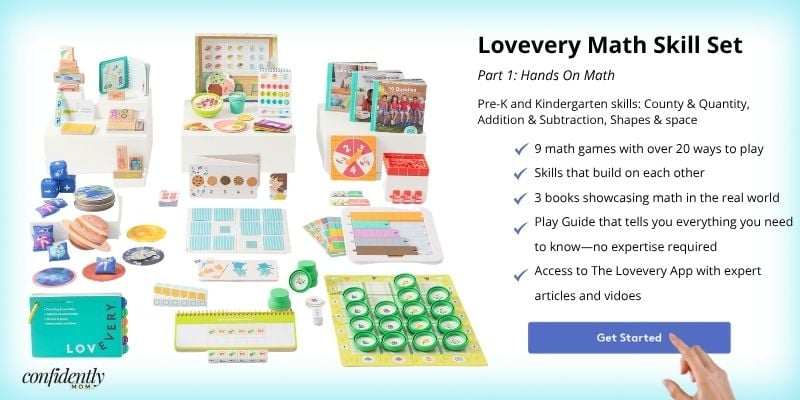
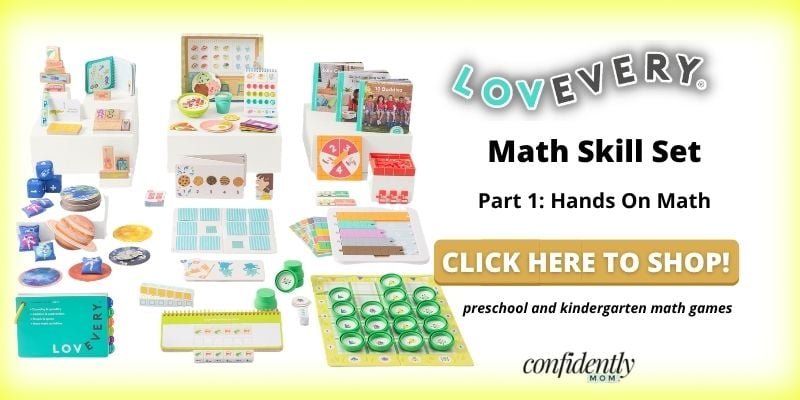
“Part 1: Hands-On Math” Set focuses on Counting & Quantity, Addition & Subtraction, and Shapes & Space. Largely this is focused on early math skills and most targeted towards preschool and kindergarten math skills. However, as you'll see in the deep dive of each item below, the games cover a wide range. You can absolutely flex or be used with older siblings up to like 10 years old for some of them. My oldest is in second grade, and thoroughly enjoyed most of the games.
Quantity & Counting
Counting Cups:
Counting Cups comes with a double sided game board, 20 collapsible silicone cups, and 20 double sided coins. You can play 3 different games with this.
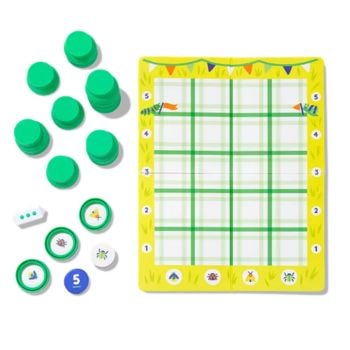
The first is Bug Dash I really like this game, it starting to mentally map graphing while also working basic 1-1 correspondence counting skills.
Second is Cup Swap. I like the IDEA of this game but it fell kind of flat for us. Basically it’s two players, each starting with ten cups using the opposite side of the board as Bug Dash. I like that it introduces the 10 frame, but the instructions were unclear, because it says you place the cups you took from your opponent on your side of the mat, which would mean you need 5 to win, but then it goes on to say the winner is whoever collects all of the cups, but you need more than 10 spaces for it.
It feels like you’re starting with too many cups or should just not use the 10 frame to play. I love the idea of introducing the mental map for 10 frames which they'll later need, and this helps with subitizing numbers more quickly, but my kids and I just sort of made up our own rules so with that in mind we play it the following two ways:
- Each gets 5 cups, and we play with only the 5 tokens, using the 10 frame board.
- Or we just ignore the board and focus on counting and play with all 10 cups and the 10 tokens.
Once we sorted out our rules, it didn't fall flat for us anymore and was fun. This was the only game we really had this issue with, which is saying something because the set includes 9 “games” but within those games, you have upwards of 20 different ways to play.
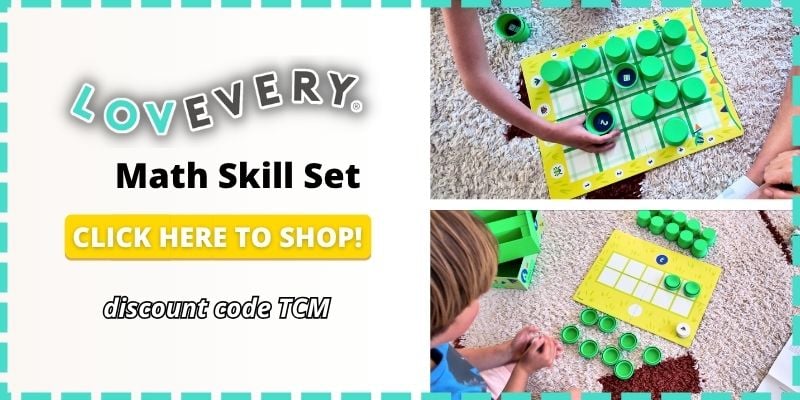
The third game is Number Match, which is basically a memory game with the tokens placed inside of the cups, and the challenge/skill they work is the ability to look at the actual digit and quickly convert/remember what it looks like in quantity. This was areally nice challenge and twist for my 4 and 7 year old.
Alternatives
I don't think there is any single item on the market that works all three of these skills in one box like Lovevery does.
And I will say, working 1-1 correspondence is a skill you can do with just about anything, and Lovevery even has several items that support this in their play kits. So this was one of my “ok” items that I could've taken or left – but again my kids are probably a bit beyond the intended start age of this set. As far as alternatives:
- Lakeshore Learning Hands-On Graphing Tray (counters are sold separately)
- Counting Bears
- Learning Resources Connecting Ten Frame Trays: teaches 1-1 correspondence, recognizing numbers in 10 frames, and can grow with child as 10 frames connect for multiplication later on
- Jumbo Magnetic Ten Frame Activity Set: 1-1 correspondence, activity cards for math problems, math rules, and exploring numbers with their corresponding quantities. (my pick out of these because it has the activities done for parent)
- Zingo 1-2-3: Basically Bingo, with your sheet having the quantity/written word, and the Zingo machine churns out the numeral you have to match on your card
- Number Puzzle Set: 20 puzzles sets feature 2 and 4 piece puzzles where they match the numeral with quantities going up to 20

Number Builder Board
This is really cool and both my 4 and 7 year old had fun with it.
Basically it has 3 difficulty levels with double sided sheets that begin teaching addition and subtraction skills and early graphing skills as well since the mystery puzzle has you tracking up to the number.
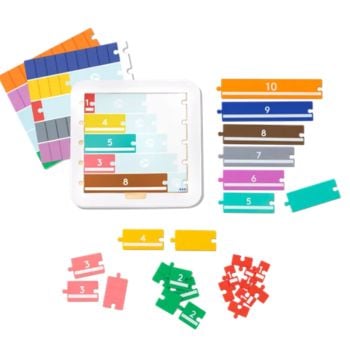
You set the board up with the revealed pieces. With my younger kid, I had him count to figure out the answer, but for my 7 year old, I had her do addition and subtraction to find the missing number. When they think they have the correct missing piece they lay it over the darker blue and it should line up properly if they are correct.
Alternatives:
- Number Bond House Board which isn't as clean/open and go feeling as Lovevery as it's jumping between numeral and written word, then you have activity cards that phrase things in more complex ways than Lovevery's.
- Montessori math strips brings in more of Lovevery's simplicity, goes beyond the number 10 though, and really drives home the “putting numbers together and taking the apart” concept to understand the relationships between numbers (my pick)
Total Up Train Game
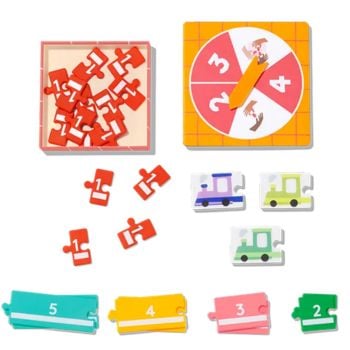
This comes inside the Number Builder Board box and follows a similar concept. Using the same pieces, you flip over the board and put the sheets aside since you won’t need them. Then you gather two 2's, 3's, 4's, and 5's then one of each other number for the more challenging version. You then have to spin and add the track to your train, whoever builds the longest train wins.
Alternatives:
The previously mentioned Number Bond House Board and Montessori math strips both work similar concepts. You can also go simpler with this magnetic train board; which brings in the train concept, has a control of error in the sense that there are only the correct matching number of balls they’ll have to move while counting, and you can use similar dialogue “You have 5 pieces in, and 3 pieces left, how many total will you have” or “You're filling the 8 car, you have 5 pieces in, how many more do you need to fill it up?”
Addition and Subtraction
Count on Cafe
This is a really cute restaurant style game. It comes with a drink, plate, and bowl that have double sided cardboard cutouts of the menu items. The server, then marks what the person is having on their pad, and tallies up the total for the customer who pays using the pretend money. The top of the box, cleverly doubles as a menu board.
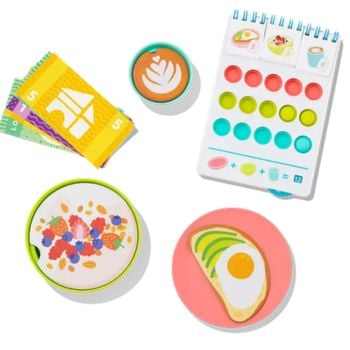
This actually pairs perfectly with a discontinued Lovevery item, the wallet. But you could easily use an old one or buy a cheap one if you’d like to add that in. Plus it works great with the Lovevery Play Kitchen.
My kids quickly took to this item in their pretend kitchen play. They fought over who got to be the waiter doing the math. And now we store this in their kitchen to use independently whenever.
Alternatives
While plenty of menu and pretend money sets exist out there, none break things down quite like Lovevery's which is really catering towards that younger group just learning to count and do math skills.
For example, this set is one of the most affordable, including 3 different menus for time of day and pretend money, plus an ordering pad. However it requires kids to be able to WRITE the menu item on the pad (vs just finding the picture) and then they have to do the mental math of the numbers; whereas Lovevery has the push popper component to keep track of their running total as they count. The level of detail Lovevery provides, really sets young kids up for the win and building their confidence momentum in math compared to alternatives.
- Breakfast, Lunch, Dinner Menus, with pad and money (top pick)
- Grocery set up with register
- Store set, with cards and piggy bank
Plus & Minus Space Missions
This cooperative space themed math game comes with three play modes: addition, subtraction, or mixed.
Basically you work as a team to get your astronauts back to Earth before the asteroid.
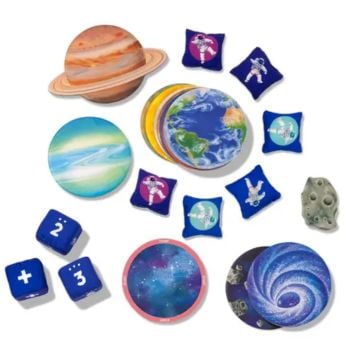
My kids really like this game. My son is super into space so it was very on theme for this stage. We actually have a game very similar to this called Hoot Owl Hoot (which I shared in my post on best preschool board games). The focus is on colors not numbers though. However the strategy is the same between the two games. So this was a really fun tweak to a family favorite that brings in math. My kids actually prefer Lovevery's.

Alternatives
Math Island – this was our family favorite addition and subtraction math game. It features a similar concept with the die, where you have to add or subtract depending on what you get, and you’re essentially racing around a volcano. I’d say my kids like this equal to the space one, but I like that Lovevery's is cooperative instead of competitive like Math Island.
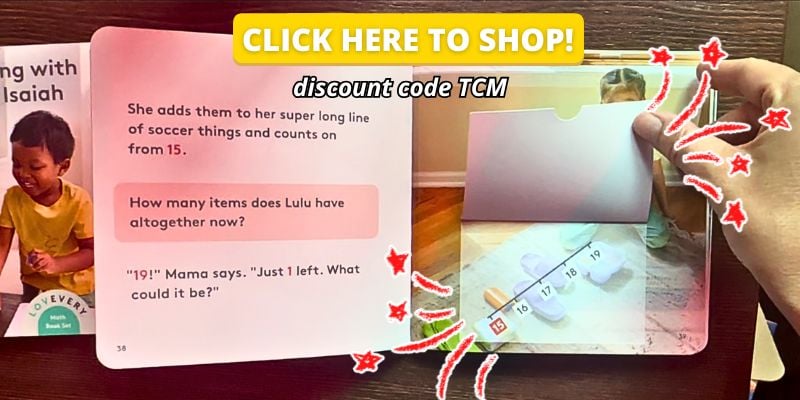
Addition Strategies Book Set
Three books featuring real kids, working on real math concepts: counting, adding to 10, and skip counting by 2's.
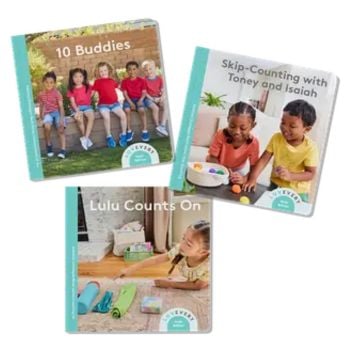
These are fun, interactive, with creative lift the flaps to check their answers. My youngest especially enjoys them.
Alternatives:
- Apple Countdown – sing-songy preschool book on counting down from 20
- How Many – A counting book featuring real life/objects, but is super open ended to encourage critical thinking skills that can adapt to a wider variety of counting and skills. For example, a picture of shoes that asks “how many?” could mean the shoes, the box, or the wholes for the shoe laces, giving kids a lot of room to fill in the space, and challenge their counting skills.
- Ten Friends – a story plus activities all about adding to 10
- Ten Flashing Fireflies – A more sing-songy rhymey type of book that gentle locks teaches adding to 10
- Eggs and Legs – skip counting by 2's
Number Sense Game Set
I wish I could put into words just HOW much I love this one when I say if you're on the fence, this game set makes the entire box worth it!
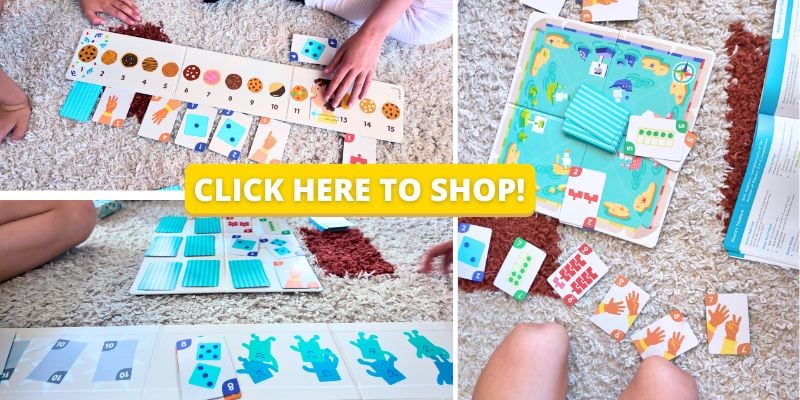
It comes with 12 games built into one tiny box. It packs a POWERFUL punch working counting, addiiton, and subtraction skills.
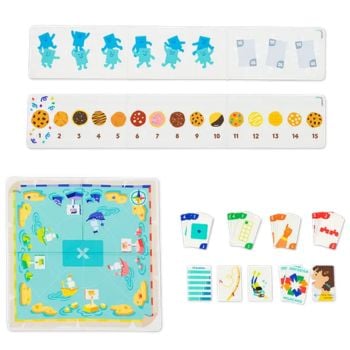
Inside you'll find 3 double sided game boards and a deck of cards that includes specialty cards depending on which game you’re playing.
The instruction manual has a quick reference of what you need for each game to quickly set up.
And the difficulty level of the games is a really nicely spread. . Meaning kids won’t grow out of the set as a whole quickly. Even after basic concepts are mastered in some of the easier games kids will work on doing it faster or with more strategy.
For example, my 7 year old knows how to count backwards and forwards and to 1,000 and all the things. The Cookie game is basically just counting down from 15. She's well beyond that. However, she's obsessed with playing thanks to the strategy of trying to block others from getting the last cookie.
The Pirate game was my personal favorite, and the kids felt it was too challenging at their ages with the “steal” concept in play.
This set will easily go from 2 years old, in the basic counting and matching games, to 8-10 years old mastering quick mental math and some strategy. It’s really a great sibling or mixed age kid set, with a ton of options to prevent burnout as they work on learning, then refining their math skills.
And I want to stress that last point: it's the VARIETY of the games that really prevent “math drills/game burnout” unlike almost anything else I've encountered.
Alternatives
Truthfully, the closest alternative would probably just be a deck of cards. Obviously you can't play the games that require Lovevery's game boards or specialty cards. However you can recreate most of the games with a deck of cards.
With that said, I don't think my brain would remember all of the games. Plus the cute specialty cards really gear things towards preschool and kindergarteners.
With that said, if you're looking for a card game activity set like Lovevery's, then Wild Side Number Sense Cards is going to be your best pick. It includes 50ish games featuring addition, subtraction, and multiplication. Overall, this dupe is better suited for older kids. I'd personally get this if my kids were beyond this set.
Shapes & Space
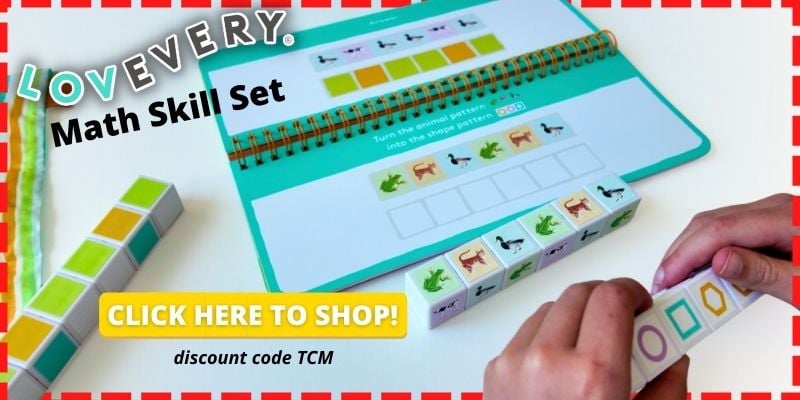
Twist & Turn Pattern Maker
Three turnable pattern strips and a guidebook with four stages: Copy, Continue, Translate, and Complete.
It’s simple, comes with a travel bag, and has answer keys on the back of the page, making it a great travel and independent play option.
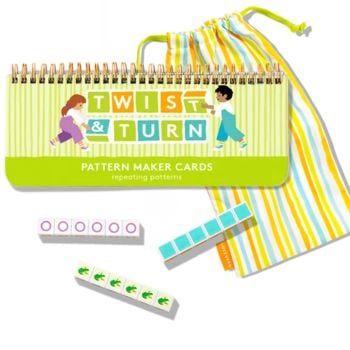
I’d say this one probably best for like 2-5 year olds. For my oldest, I had to tell her that the “translate” cards were the pre-step to decoding secret messages which got her excited and into practicing it, but this is probably her least played with item in the set.
Alternatives
Nothing exactly like Lovevery's but some options, none of which include the “translate” option of Lovevery's:
- Pattern and Sequencing Activity Cards – sequencing cards, you need to buy bears separately
- Pattern Recognition – card game teaching a variety of patterns and sequencing
- Numberblocks Pattern Palace board game – board game so kids need someone to play with, but a fun pattern game, that also works counting and addition skills (my pick)
Stack It Up Measurement Game
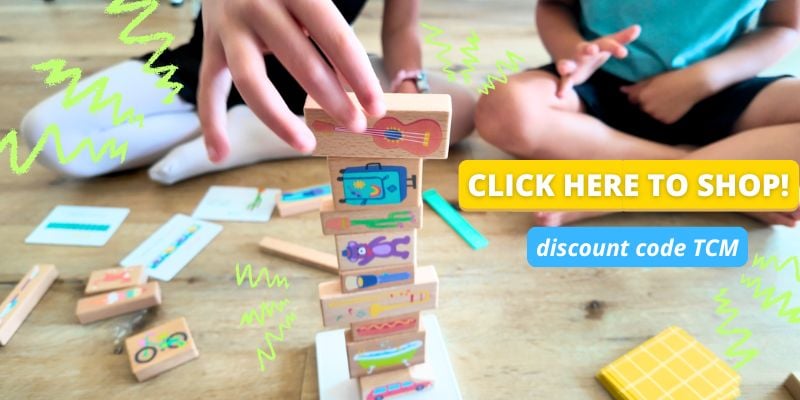
This is a really fun introduction to measuring game that gives Jenga vibes.
Basically you pull a card, find a block that matches the description, if none do you toss the card and redraw, and try to stack all 18 blocks onto the car for your trip.
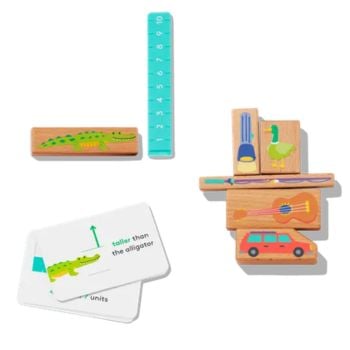
I will say, for younger kids, I don’t think many will have enough body control to stack all 18 blocks to “win” so for younger kids, I would suggest saying you need to stack like 8 to win, then build up from there.
This game can be played alone if they can read/understand the cards (which Lovevery did a great job visually showing what the card was asking for as long as they know their numerals whether or not the kids can read) or with others which is nice too.
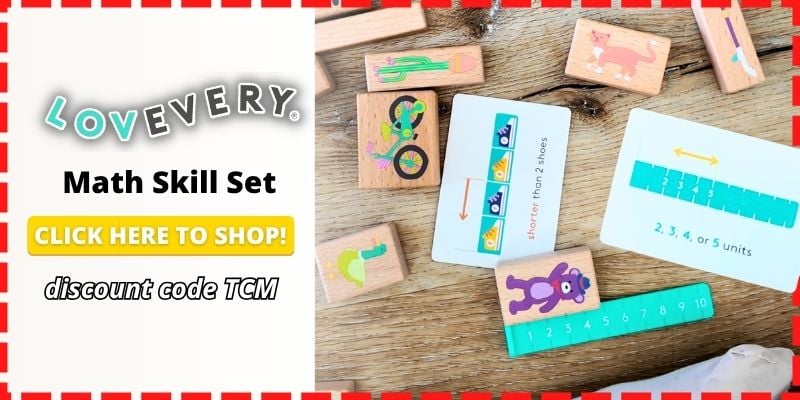
This one was a huge hit with my kids who asked to play again and again, and even practice on their own.
Alternatives
Educational Insights Reel Big Catch Game basically has these telescoping fish, that you fish for, and reveal how long it is, you measure it, and the biggest catch wins.
How Tall Am I? Has you flicking a spinner to collect pieces and build silly animals, the measure to se how got the tallest.
Pack It Up Spatial Game
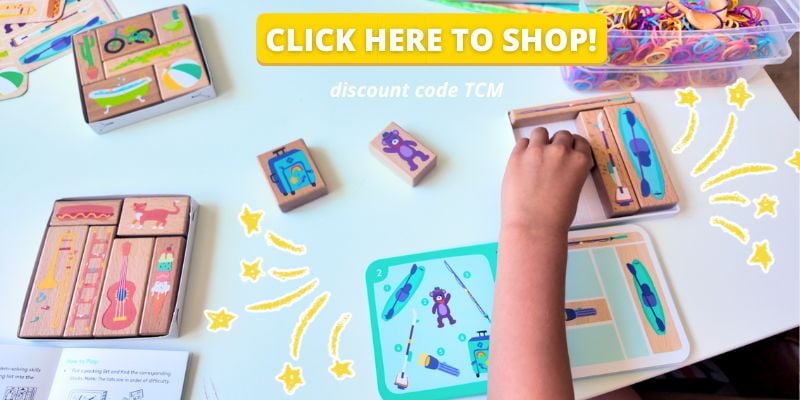
One of my kids favorites in this entire box. I used to do puzzles like this in school as a kid and remembered LOVING it so I’m not surprised at all it’s the most fought over item.
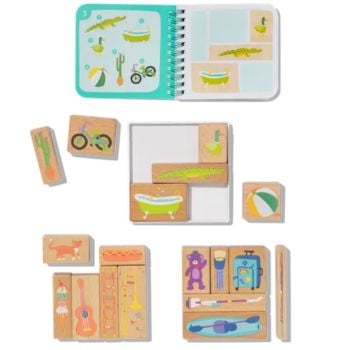
Basically it comes with three double sided wooden block trays, a game board, and a puzzle booklet that gets progressively more challenging as they work on spatial relations, with fewer pieces identified, and then even removing the shape of the blocks.
My 4 year old played with this quietly for hours and hours. The first sitting alone he went straight through to puzzle 15 until he was so tired and stumped that I encouraged a little break, which he reluctantly agreed to and was back at it the next morning before we were down for breakfast.
My 7 solved it all the first day, but has kept going back to it over and over.
Alternatives
The most similar option I found is this “Road Trip Packing Puzzle” which is geared towards older kids with more intricate shapes.
But as far as working on just spatial relations with littles, then tangram puzzles are usually a good starting point.
Lovevery Math Skill Set Quantitative Review:
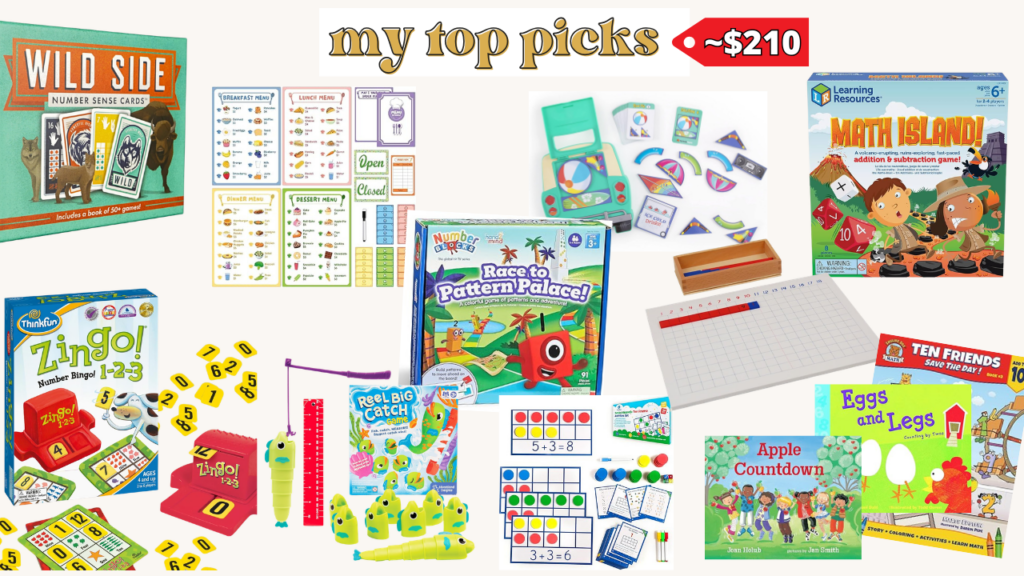
If you were to get all of the cheapest alternatives I recommended, totaling 12 items (counting each book separately) you're looking at $152.
If you were to get all of the most expensive ones, you're looking at $259
And if you were to get my top picks you're looking at somewhere in the middle, still coming in quite a bit more than the cost of Lovevery!
Part 1 Personal Review of the Lovevery Math Skill Set
Like I've said repeatedly, I'm really impressed with Part 1 of Lovevery's Math Skill sets. My youngest is in that sweet spot age range for who this is for. While I homeschool my oldest, he plays an independent game from this and loves it. My oldest is technically beyond the intended age range of this set. Which made me that much more impressed by her interest/enthusiasm for playing most of the games.
The major thing I think Lovevery's Math Sets resolves is math drill burnout. You can say this includes 10 items, or 12 if counting the books separately, but the reality is, there's over 20 ways to play the 9 actual games included. That variety is HUGE when mastering repetitive math concepts without the burnout. Personally think this should be in every classroom and homes that love educational or puzzle like toys.
I love how many of these can be played alone too.
Future Releases of Lovevery's Math Skills Program
- Part 1: Hands-On Math – Available now
- Part 2: Real-World Math (Available for pre-order May 14, ships in October) – Kids apply math to everyday skills like time and money.
- Part 3: Problem Solving with Math (Coming 2027) – Explore bigger ideas like fractions and real-world problem solving.
Related Reads
Lovevery Reviews
Lovevery Playkit Subscription Review: Worth It?
Lovevery Block Set Review: Is It Worth It?
Lovevery Montessori Play Shelf Review
The Looker Play Kit for weeks 0-8
The Charmer Play Kit for months 3-4
The Senser Play Kit for months 5-6
The Inspector Play Kit for months 7-8
The Explorer Play Kit for months 9-10
The Thinker Play Kit for months 11-12
The Babbler Play Kit for months 13, 14, 15
The Pioneer Play Kit for months 16, 17, 18
The Realist Play Kit for months 19, 20, 21
The Companion Play Kit for months 22, 23, 24
Lovevery The Helper Play Kit Review For 25, 26, 27 Months: Worth It?
Lovevery The Enthusiast Play Kit Review For 28, 29, 30 Months
Lovevery The Investigator Play Kit Review For 31, 32, 33 Months
The Free Spirit Play Kit for months 34, 35, 36
Lovevery Observer Play Kit Review
Lovevery Storyteller Play Kit Review
Lovevery Analyst Play Kit Review
Lovevery Problem Solver Play Kit Review
Lovevery Connector Play Kit Review
Lovevery Examiner Play Kit Review
Lovevery Persister Play Kit Review
Lovevery Planner Play Kit Review: Worth It vs Amazon Self Curating?
Kiwi Co Reviews
Best KiwiCo Panda Crates Ranked By Age [Plus Discount code TCM!]
How Does KiwiCo Work? “Start With This Crate” Subscription, Store, Gifting + more!
KiwiCo Panda Crate Plus Review: Upgraded Toys Any Good?
KiwiCo Koala Crate Review: Is It Worth It for 3 to 4 year olds?
KiwiCo Panda Crate Review: Count With Me for 13-18 month olds
KiwiCo Panda Crate “Solve With Me” for 18-24 months
KiwiCo’s Panda Crate: “Look With Me” Review: Worth It?
KiwiCo Panda Crate Discover With Me Review: Worth it?
KiwiCo Panda Crate vs Lovevery: Which baby subscription box is best?
Gift Guide: KiwiCo Toys + Science Kits for Babies, Toddlers, and Little Kids!
Montessori Gift Guides
Montessori Baby Toys For 0-6 Months
Montessori Gift Ideas 6-12 Months
Montessori Gift Guide For 1 Year Old to 2 Year Olds
Ultimate Gift Guide Of Montessori Toys For 2 to 3 Year Olds
Montessori + Waldorf Gifts For 3 to 4 Year Olds